
Mainland vs Free Zone vs Offshore: UAE Jurisdiction Guide

A common and costly mistake foreign founders make when setting up in the UAE is picking a jurisdiction based on what a friend did rather than what their business model actually requires. One founder hears that Dubai Mainland worked well for a restaurant owner. Another sees a LinkedIn post about a free zone and assumes it covers everything. Neither started from the same business model, and neither will end up with the right structure.
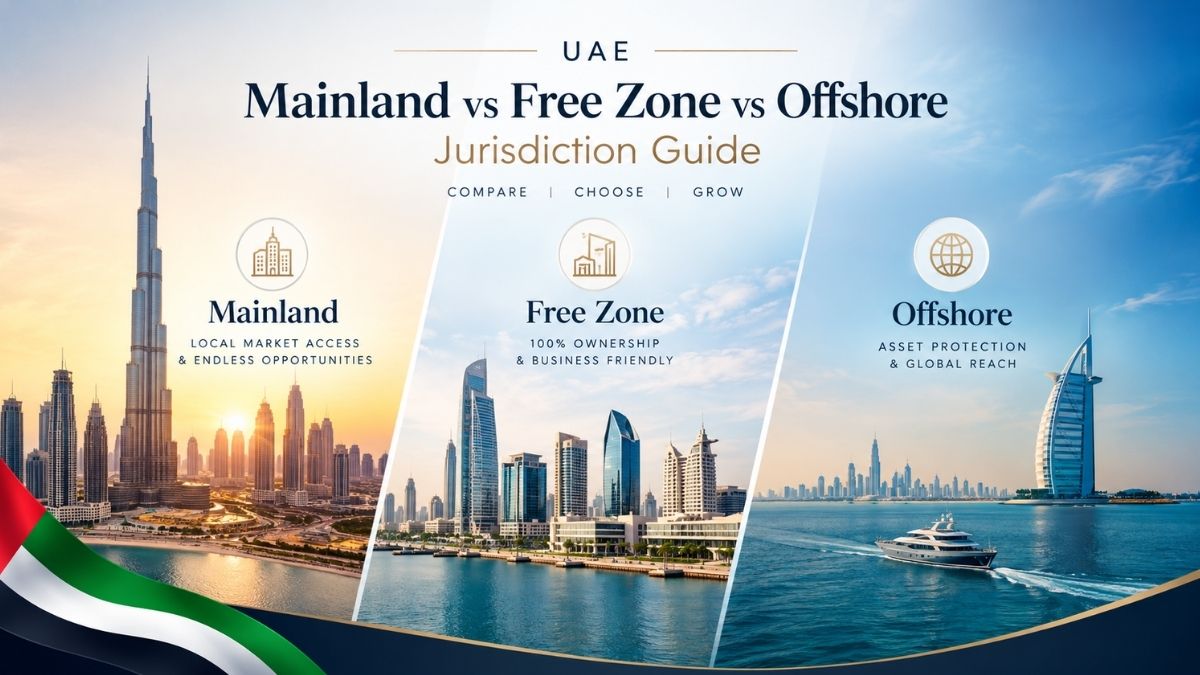
The UAE has three fundamentally different company structures: mainland, free zone, and offshore. Each has distinct trading rights, a different cost profile, and a separate legal framework. They are not interchangeable, and the wrong choice costs real money to unwind. At Hope Ventures, the consultants frequently work with founders who assumed all UAE entities function the same way, only to discover their structure blocks them from the market they actually want to serve.
This UAE jurisdiction comparison guide walks through each structure in detail. By the end, you’ll know which jurisdiction fits your specific business model, or at minimum, which two to shortlist before talking to an advisor.
- What Each UAE Jurisdiction Is Actually Designed For
- Mainland: Built for UAE Market Operations
- Free Zone: The 100% Ownership Play for International Business
- Offshore: Holding Structures, Not Operations
- UAE Jurisdiction Comparison: Ownership Rules, Licensing Scope, and Trading Rights
- How 100% Foreign Ownership Actually Works Across Structures
- Trading Rights and Activity Restrictions by Jurisdiction
- What You Actually Pay: Setup Costs and Ongoing Fees
- Visa Eligibility, Staffing Capacity, and Office Requirements
- Banking Access and Legal Dispute Frameworks
- UAE Jurisdiction Comparison: Matching Your Business Model to the Right Structure
- The Bottom Line
What Each UAE Jurisdiction Is Actually Designed For
Mainland: Built for UAE Market Operations
Mainland companies are licensed by the emirate’s Department of Economic Development and carry the broadest market access of any structure in the UAE. They can trade freely across the country, serve local consumers and businesses, and bid on government contracts. If your revenue depends on direct access to UAE customers, this is your structure.
The trade-off is a heavier compliance footprint. A physical, Ejari-registered office is non-negotiable. Regulatory requirements are broader than what free zones impose, and some activities still carry sector-specific approval requirements. For businesses genuinely targeting the UAE market, that overhead is justified. For businesses that primarily serve international clients, it usually isn’t.
Free Zone: The 100% Ownership Play for International Business
Free zones were built to attract foreign investment into export-oriented, digital, and internationally focused businesses. They allow full foreign ownership and offer faster, simpler setup than mainland. There are over 40 free zones in the UAE, each with its own licensing authority, cost structure, and activity list.
The limitation that trips up most founders: free zone companies cannot directly trade on the UAE mainland without a separate arrangement, such as a local distributor or a mainland branch. A DMCC license gives you global trading rights and zone-to-zone commerce, but it does not give you the right to walk into a Dubai retail outlet and start selling. For e-commerce, consulting, tech, and export-oriented businesses, this limitation rarely matters. For businesses that need local UAE B2B or B2C access, it’s a real constraint.
Offshore: Holding Structures, Not Operations
Offshore entities serve a completely different purpose. They exist for asset protection, IP holding, international investment structures, and shareholder layering, not for running an active UAE business. An offshore company cannot conduct direct commercial activity in the UAE, has no visa entitlements, and requires no physical office.
They are the cheapest structure to establish and maintain, but they give the founder nothing in terms of UAE market presence or residency. If you’re building a holding layer above operating entities or protecting assets across jurisdictions, offshore works well. If you want to run a business in or from the UAE, it doesn’t.
UAE Jurisdiction Comparison: Ownership Rules, Licensing Scope, and Trading Rights
How 100% Foreign Ownership Actually Works Across Structures
All three structures can be 100% foreign-owned, but the path and implications differ. Free zones have always permitted full foreign ownership by design. Mainland rules have relaxed significantly under federal law reforms, with many commercial activities now open to full foreign ownership. Offshore structures are inherently foreign-owned holding vehicles.
The phrase every founder needs to internalize: 100% ownership does not equal unrestricted market access. A RAK FTZ entity can be entirely foreign-owned and still be legally blocked from direct mainland sales without an intermediary. Ownership and market access are separate questions, and conflating them is one of the most common errors in UAE company formation planning.
Trading Rights and Activity Restrictions by Jurisdiction
Mainland licenses cover the broadest range of activities and all geographies within the UAE. Free zone licenses are activity-specific and zone-anchored: a DMCC trading license does not allow that same entity to open a retail outlet in Abu Dhabi or serve UAE government tenders. Offshore entities have the narrowest scope of all, with no UAE-based commercial activity permitted.
For businesses that need to operate across multiple emirates, hire staff locally, or serve UAE government entities, mainland is the only practical option. For everyone else, the question shifts to which free zone best matches the activity type, cost budget, and visa requirements.
What You Actually Pay: Setup Costs and Ongoing Fees
First-Year Setup Costs Across Major Jurisdictions
Costs vary significantly across structures and specific zones. Dubai Mainland setup typically runs AED 15,000 to AED 50,000 or more in the first year, depending on activity, office lease, and any regulatory approvals required. DMCC, one of the premium free zones, sits at roughly AED 35,000 to AED 50,000 for the first year. DIFC carries a lower headline setup fee of around AED 12,000 per its published fee schedule, but the mandatory physical office requirement adds AED 15,000 to AED 50,000 on top of that.
RAK Free Zone options, including Al Hamra Free Zone where Hope Ventures is headquartered, represent some of the most cost-efficient entry points in the market. Entry-level packages start significantly below Dubai free zone benchmarks, with typical business packages in the AED 11,000 to AED 25,000 range depending on activity, office type, and visa count. Offshore structures carry the lowest setup and maintenance cost across all three structures.
Annual Renewal Fees and What Drives Cost Over Time
Annual license renewal is an ongoing cost that founders consistently underestimate at the planning stage. Mainland renewal costs are tied to office lease value and license type. DMCC’s annual license renewal ranges from AED 10,000 to AED 50,000 depending on activity and visa allocation, based on DMCC’s published fee tables. RAK Free Zone renewals are more predictable, with entry-level zero-visa packages renewing at around AED 6,000 and standard packages with visas ranging from AED 8,000 to AED 12,000 plus visa costs.
The total cost of ownership over three years tells a very different story from the first-year headline number. A low-cost zone that forces an office upgrade in year two can quickly match a premium zone’s economics. Hope Ventures builds that three-year view into every jurisdiction recommendation so clients understand the true cost before they commit.
Visa Eligibility, Staffing Capacity, and Office Requirements
How Jurisdiction Choice Shapes Your Visa Allocation
Mainland companies offer the most flexible visa capacity, with allocation tied to office size rather than a fixed package quota. Free zone companies can sponsor investor and employee visas, but the number is typically capped by the office arrangement. As an illustrative guide based on common free zone policies: a flexi-desk arrangement generally supports two to three visas, a serviced office four to five, and a dedicated physical space unlocks larger allocations tied to square footage. Exact quotas vary by zone, so confirming with the relevant licensing authority is always advisable.
Offshore entities cannot sponsor any UAE residence visas. For American founders planning to relocate to the UAE, live there while running their business, or sponsor family members on a dependent visa, an offshore-only structure is a non-starter. The visa question alone eliminates offshore as the sole structure for anyone who wants to actually live in the country.
Physical Office Requirements Across All Three Structures
Mainland companies require a physical, Ejari-registered office without exception. Free zones vary considerably: some permit virtual offices or flexi-desk arrangements that satisfy licensing requirements without a full office lease, while others require dedicated physical space depending on the activity type. This distinction matters enormously for US-based founders running lean operations who want a UAE legal entity without committing to a full office overhead.
Offshore companies have no office requirement at all, which explains both their low maintenance cost and their zero UAE market access. The absence of local presence is structurally linked to the absence of local trading rights.
Banking Access and Legal Dispute Frameworks
Opening a Corporate Account: Which Jurisdiction Makes It Easier
UAE corporate banking has tightened across the board, but jurisdiction still influences access and approval speed. Mainland companies generally have a smoother path to onshore UAE bank accounts, partly because their physical presence and local trading activity signal substance to compliance teams. Free zone companies can open accounts, but some banks are more selective about certain zones or activity types. The process involves a KYC review that typically covers the trade license, constitutional documents, UBO declarations, a business plan, and expected transaction flows.
Offshore entities face the hardest path to UAE banking and are often better served through international banking relationships outside the country. Hope Ventures provides bank introduction support across all three structures, removing one of the biggest friction points founders face when setting up remotely from the United States.
DIFC and ADGM Courts vs UAE Federal Courts: Why It Matters for Contracts
If your business involves significant contracts, IP agreements, or investment activity, the legal framework governing your disputes is worth understanding before you sign anything. DIFC and ADGM operate as independent common-law jurisdictions within the UAE, applying English common-law principles rather than UAE civil procedure. This appeals to international businesses that want English-style contract enforceability and familiar arbitration frameworks.
UAE federal courts apply UAE civil law and are the default forum for mainland disputes. DIFC judgments can be enforced in Dubai’s onshore courts through a judicial cooperation protocol. The creditor obtains an execution letter from the DIFC Courts Registry, submits it with an Arabic translation to the Dubai execution judge, and enforcement proceeds without re-litigating the merits. ADGM judgments carry recognition mechanisms in UAE federal courts, though the process differs from the DIFC-Dubai channel.
For most SMBs and early-stage founders, standard free zone frameworks and federal courts are more than adequate. For financial services firms, fund structures, or complex joint ventures, DIFC or ADGM jurisdiction deserves serious consideration from the outset.
UAE Jurisdiction Comparison: Matching Your Business Model to the Right Structure
A Practical Decision Framework for Foreign Founders
The right structure comes down to three core questions. Do you need to sell directly to UAE customers or bid on government contracts? If yes, mainland is non-negotiable. Is your business internationally focused, digital, or export-oriented, and do you want to minimize setup cost and compliance burden? A free zone, especially a cost-efficient one like RAK Free Zone, is almost always the better fit. Do you need a holding structure, asset protection vehicle, or international ownership layer with no UAE operational presence? That is offshore territory.
Many founders choose free zones as their starting point. But the specific zone, whether DMCC, JAFZA, RAK FTZ, or DIFC, depends on activity type, visa count, banking relationships, and budget. DMCC suits commodity trading and financial services. JAFZA fits logistics and warehousing. RAK FTZ delivers strong value for e-commerce, consulting, and service businesses where cost efficiency matters more than a premium address.
Why Hope Ventures Evaluates Each Client’s Goals Before Recommending a Jurisdiction
There is no universal right answer in a UAE jurisdiction comparison, and that is exactly the problem with generic advice. Hope Ventures starts every engagement with a structured business goals review: what the founder wants to sell, to whom, from where, with how many employees, and on what timeline. From that picture, the team recommends the specific jurisdiction and structure that aligns with those goals.
As a consultancy headquartered in Al Hamra Free Zone in Ras Al Khaimah, Hope Ventures has direct expertise in RAK FTZ’s cost and speed advantages. The team also places clients in DMCC, Dubai Mainland, and offshore structures when those are the right fit. The result is a recommendation built around the client’s business model, not a one-size-fits-all package pushed at every inquiry.
The Bottom Line
The decision logic is straightforward once you frame it correctly. Mainland gives you UAE market access at higher cost and compliance. Free zones give you 100% ownership, international trading rights, and leaner setup, with the trade-off that you stay out of direct mainland commerce. Offshore gives you the lightest structure for holding and asset protection, with no visa eligibility and no UAE market presence at all.
The cost gap between jurisdictions is real, but operational fit matters more than the setup fee. A structure that costs AED 5,000 less to incorporate but blocks you from your target market carries a much steeper price over time. A free zone entity that cannot legally serve UAE mainland B2B clients, for instance, may cost a founder more in lost revenue than the savings ever justified.
If you’re still working through which structure fits your business, this UAE jurisdiction comparison is a starting point, not a substitute for tailored advice. Hope Ventures offers a consultation to evaluate your specific setup and map out a clear path forward. The recommendation follows the business model, not the license price tag. Reach out to the Hope Ventures team and get a jurisdiction recommendation built around what your business actually needs.


