
Start a UAE Company from the USA: A Step-by-Step Guide
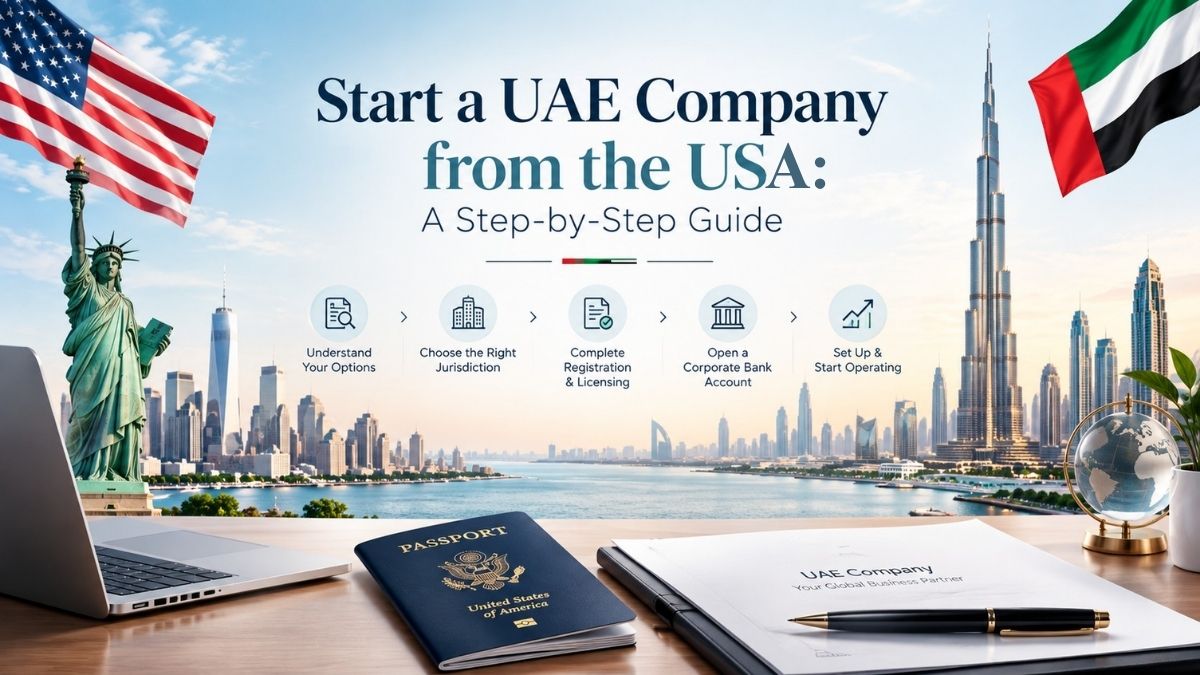

You’re sitting in Chicago, Austin, or New York. You’ve decided to register a company in the UAE, and the process looks like a maze from 7,000 miles away. The licensing authorities are in a different time zone, the documents need signatures you’ve never heard of, and you’re not sure whether to set up in a free zone or on the mainland. The good news is that learning how to start a UAE company from the United States is genuinely straightforward once you understand how each piece connects. American entrepreneurs are increasingly structuring businesses through the UAE for its zero personal income tax environment, 100% foreign ownership, and strong access to Gulf, Asian, and African markets.
This guide walks through every major step: choosing the right structure, preparing your documents correctly, completing registration remotely, opening a corporate bank account, and securing your investor visa. You won’t need to book a flight to Dubai to get started. Hope Ventures (HVUAE), headquartered in Ras Al Khaimah’s Al Hamra Free Zone, handles the UAE side for US founders end to end, from trade name reservation through license issuance and bank introductions.
- Why US Founders Are Structuring Businesses Through the UAE
- How to Start a UAE Company from the United States: Choosing Your Structure
- Documents You Need to Prepare Before You Apply
- How the Registration Process Actually Works from the US
- Opening a UAE Corporate Bank Account from Overseas
- UAE Investor Visas and Residency for Founders Based in the US
- Ready to Start Your UAE Company from the United States?
Why US Founders Are Structuring Businesses Through the UAE
The Tax and Ownership Case for American Entrepreneurs
The UAE charges zero personal income tax. There’s no capital gains tax, no withholding tax on dividends, and full profit repatriation is permitted. Following amendments to the UAE Commercial Companies Law, 100% foreign ownership is now permitted across most sectors in both free zones and mainland jurisdictions. This isn’t a loophole or a traditional tax shelter; it’s how the UAE is deliberately structured to attract global capital and entrepreneurship.
American founders need to stay clear-eyed about one reality: US citizens are taxed on worldwide income regardless of where they live or where their business is registered. IRS reporting obligations, including FBAR (FinCEN Form 114) and FATCA (Form 8938), apply to your UAE bank accounts if aggregate balances exceed $10,000 and $50,000 respectively. Consult IRS and FinCEN guidance directly to confirm current thresholds and filing requirements. Compliance awareness is non-negotiable from day one, and a qualified formation partner should flag this upfront.
The UAE as a Bridge Between the US, Middle East, and Asia
A UAE entity gives American businesses a credible local address to invoice clients across the Gulf Cooperation Council, Southeast Asia, and East Africa from a single hub. Strong US-UAE trade ties, a USD-pegged currency, and the UAE’s growing position as a global logistics and fintech center make it one of the most practical international structures available to American founders right now. Whether you’re in e-commerce, professional services, or tech, a UAE free zone company lets you accept payments in multiple currencies, hold international banking relationships, and operate in markets that a US-only entity makes difficult to access.
How to Start a UAE Company from the United States: Choosing Your Structure
Free Zone Companies: A Popular Starting Point for US Founders
Free zone entities offer 100% foreign ownership, exemption from import and export duties, tax exemptions on qualifying income, and fast remote setup. Many US founders begin here. The main restriction is that a free zone company cannot directly trade goods inside the UAE mainland without a dual license or a local distribution arrangement. For businesses focused on international operations, digital services, or B2B consulting, that restriction rarely causes problems.
RAK Free Zone (RAKEZ), which covers Al Hamra Free Zone in Ras Al Khaimah, is a cost-effective and founder-friendly jurisdiction. It’s also where Hope Ventures (HVUAE) is headquartered and where a significant portion of their US clients start. According to RAKEZ published fee schedules, license costs typically start between AED 10,000 and AED 13,000, and the license itself can be issued in 4 to 10 working days from document submission, though timelines vary based on activity type and document completeness. For a US founder who wants speed, low overhead, and a fully remote setup process, RAK Free Zone is a strong starting point worth evaluating.
Mainland and Offshore: When Each One Makes Sense
Mainland companies now permit 100% foreign ownership across most sectors, a change introduced through UAE Commercial Companies Law amendments, and allow unrestricted access to UAE customers, government contracts, and retail markets. Strategic sectors may still carry ownership restrictions, so verify your specific activity with the relevant authority. If you plan to serve local UAE clients directly, operate a physical storefront, or need a Dubai address for client credibility, a mainland entity under the Dubai Department of Economy and Tourism or another emirate’s licensing authority is worth the additional cost, typically AED 15,000 to AED 25,000 for setup.
Offshore structures, such as RAK ICC or JAFZA Offshore, are designed purely for holding assets, owning intellectual property, or structuring international investments. They cannot trade inside the UAE, and they generally don’t qualify for UAE residency visas or standard retail corporate bank accounts, though practices can vary by registry, so confirm specifics with the chosen offshore authority. The decision framework is clear: if you’re serving UAE customers, consider mainland; if you’re operating internationally with no UAE client base, a free zone works well; if you need a holding vehicle for assets or equity structures, Offshore Company Formation Process in UAE | Step-by-Step Guide is the right tool.
Documents You Need to Prepare Before You Apply
What Every Applicant Must Submit
Every UAE licensing authority requires a valid passport copy (minimum six months’ validity), recent proof of residential address (a utility bill or bank statement no older than three months), and for regulated business activities, a business plan outlining your model and financial projections. If you are applying through a formation agent like HVUAE, you’ll also need to sign a Power of Attorney authorizing that agent to act on your behalf with the licensing authority. Emirates ID is not required for non-residents at this stage, but you’ll need it later if you pursue a UAE residency visa. Always confirm the exact document checklist directly with your chosen authority, RAKEZ guide to company registration, DMCC, or the relevant DED, as requirements can vary.
Documents and Authentication
This is where US applicants run into the most delays. The UAE is not a member of the Hague Apostille Convention, and for most UAE government and free zone authorities, apostilled documents are not accepted in place of full chain legalization. A US-issued Power of Attorney typically must go through a complete authentication chain: notarization in the state where it was signed, authentication by that state’s Secretary of State, then authentication by the US Department of State, and finally legalization by the UAE Embassy or Consulate in the United States. Check directly with your chosen authority, RAKEZ or the relevant mainland body, for their specific requirements, as some free zones may have nuanced acceptance policies. Submitting only a notarized or apostilled document without completing the full chain is a common cause of rejection.
If your company has a corporate shareholder, meaning a US LLC or corporation is the investor rather than an individual, that entity’s Certificate of Incorporation and MOA/AOA documents must also go through the same authentication chain. Once fully legalized, most UAE government authorities require non-Arabic documents to be translated into Arabic by a UAE-certified translator before submission, though some free zones accept English-language documents. Confirm the requirement with your specific authority. HVUAE coordinates this entire chain for US clients, which eliminates the weeks of back-and-forth that solo applicants typically experience. For a practical checklist of the typical paperwork and translations you’ll need, see this reference on documents required for UAE company registration.
How the Registration Process Actually Works from the US
The Step-by-Step Path from Application to Trade License
The formation process follows a consistent sequence regardless of which free zone or mainland authority you choose. It begins with selecting your business activity and jurisdiction, followed by reserving the trade name with the licensing authority. Next, formation documents are submitted remotely through your appointed agent, and initial approval is issued. The Memorandum of Association is then signed, either digitally or through your notarized Power of Attorney, government fees are paid, and the trade license is issued.
For most free zone setups through RAK Free Zone, this full cycle takes between 4 and 10 working days from complete document submission to license issuance. The timeline shortens when all documents arrive correctly legalized and translated on the first submission. HVUAE manages every step in this chain, trade name reservation, authority communication, fee payments, and document submission, without the client needing to be present in the UAE at any point.
Why Having a UAE-Based Formation Partner Matters
From the US, you can’t walk into a free zone office, resolve a licensing query on the same business day, or verify a document correction in person. When a licensing authority requests a change, the turnaround time without a local representative can stretch from days to weeks. Hope Ventures (HVUAE) operates as the on-the-ground representative, communicating directly with RAKEZ and other authorities, managing rejections or document corrections, and keeping the formation on track. This is the practical reason why solo remote applications frequently stall midway through the process.
Opening a UAE Corporate Bank Account from Overseas
What Banks Actually Require and Why It Takes Time
Banking is the most challenging stage of the UAE setup process for US founders, and the reasons are worth understanding clearly. Most traditional UAE banks require at least one shareholder or authorized signatory to appear in person for KYC verification. Required documents typically include the trade license, MOA/AOA, a board resolution authorizing account opening, passport copies, six months of personal bank statements, a detailed business plan with financial projections, and a UBO (Ultimate Beneficial Owner) declaration. Compliance checks are thorough, particularly for non-resident founders from outside the region. The typical timeline from company registration to a functioning bank account is five to seven weeks, though this varies by bank and applicant profile. For an in-depth walkthrough tailored to non-residents, see our guide on Open Corporate Bank Account in UAE for Foreigners, Full Guide .
How US Founders Can Plan Around the In-Person Requirement
The most reliable approach is to schedule a single trip to the UAE after your company is registered, specifically to complete the bank account opening. This is a one-time visit, not an ongoing requirement. HVUAE offers a bank introduction service that helps match clients with appropriate banking partners, including established UAE banks such as ADCB and Emirates NBD, and prepares your documentation package to align with each bank’s KYC requirements before you arrive. This reduces the likelihood of rejection or delay during the account opening process.
Some UAE digital banks and fintech platforms, including Wio, offer more flexibility for non-resident directors, and limited remote onboarding may be available for lower-risk business profiles. Offerings and risk appetites in this space change frequently, so verify current policies directly with the provider. That said, a traditional corporate account with a major UAE bank remains the most reliable setup for US founders who need USD-compatible banking, multi-currency support, and credibility with international clients. Account minimum balance requirements typically range from AED 5,000 to AED 10,000, so factor this into your initial budget. For practical bank account documentation checklists and steps, review this resource on how to open a corporate bank account in UAE for foreign investors.
UAE Investor Visas and Residency for Founders Based in the US
What Visa You Qualify for as a Company Owner
Owning a UAE company entitles you to apply for a UAE investor or partner residence visa, which provides two to three years of UAE residency, renewable indefinitely. This visa allows you to open a personal UAE bank account, obtain an Emirates ID, and sponsor family members for residency. Visa processing costs vary by route and jurisdiction; free zone-based investor visas typically run AED 14,000 and above when you include immigration filing, medical checks, Emirates ID, and health insurance. Check the ICP (Federal Authority for Identity, Citizenship, Customs and Ports Security) or your free zone authority for current fee schedules, as costs are updated periodically. Processing takes approximately 15 to 20 working days from a complete file.
The Golden Visa, a 10-year UAE residency program, is available to founders who meet specific eligibility criteria. One qualifying pathway includes property ownership valued at AED 2,000,000 or more, though the program covers multiple categories including investors, entrepreneurs, and specialized talent, each with distinct thresholds and requirements that are updated from time to time. Refer to official UAE government sources for current criteria. Importantly, neither the standard investor visa nor the Golden Visa requires you to live in the UAE full-time, which makes both options genuinely practical for US-based founders who want UAE residency without relocating permanently.
Sponsoring Family Members from the US
An investor visa holder can sponsor a spouse and children for UAE residency as dependents. The basic requirements include a valid investor visa, proof of minimum salary or financial means, a tenancy contract, and medical fitness certificates for each applicant. Many American families explore this route when considering a Dubai or Ras Al Khaimah base without fully relocating. The ability to maintain a UAE address, keep children in international schools part of the year, and retain US ties simultaneously appeals to a growing number of American entrepreneurs.
Ready to Start Your UAE Company from the United States?
The path breaks down into five clear steps. Choose a free zone structure, RAK Free Zone is a strong starting point for many US founders. Prepare your documents with the correct authentication chain and certified Arabic translations where required. Engage a UAE-based partner to handle on-the-ground registration. Budget for the banking process and a single UAE visit to complete KYC. Then apply for your investor visa once the trade license is in hand. The total timeline from first document submission to a licensed, banking-ready company is typically four to eight weeks for a free zone setup.
Understanding how to start a UAE company from the United States becomes significantly easier when the UAE side is managed by a team that handles this process every day. Hope Ventures (HVUAE) works with US founders across every step: jurisdiction selection, trade name reservation, document collection and submission, licensing, bank introductions, and visa processing. You stay focused on building your business from the US while the setup is handled properly on the ground in Ras Al Khaimah. Also, for a concise explanation of US reporting obligations related to foreign accounts, see this primer on FBAR vs FATCA.
Get in touch with the HVUAE team to receive a transparent cost breakdown, a document checklist tailored to your business activity, and a realistic timeline for your specific setup. As their stated service model, HVUAE operates as a single-point engagement, one team managing the full process from first inquiry to a fully operational UAE company, with no handoffs to third-party vendors.


